
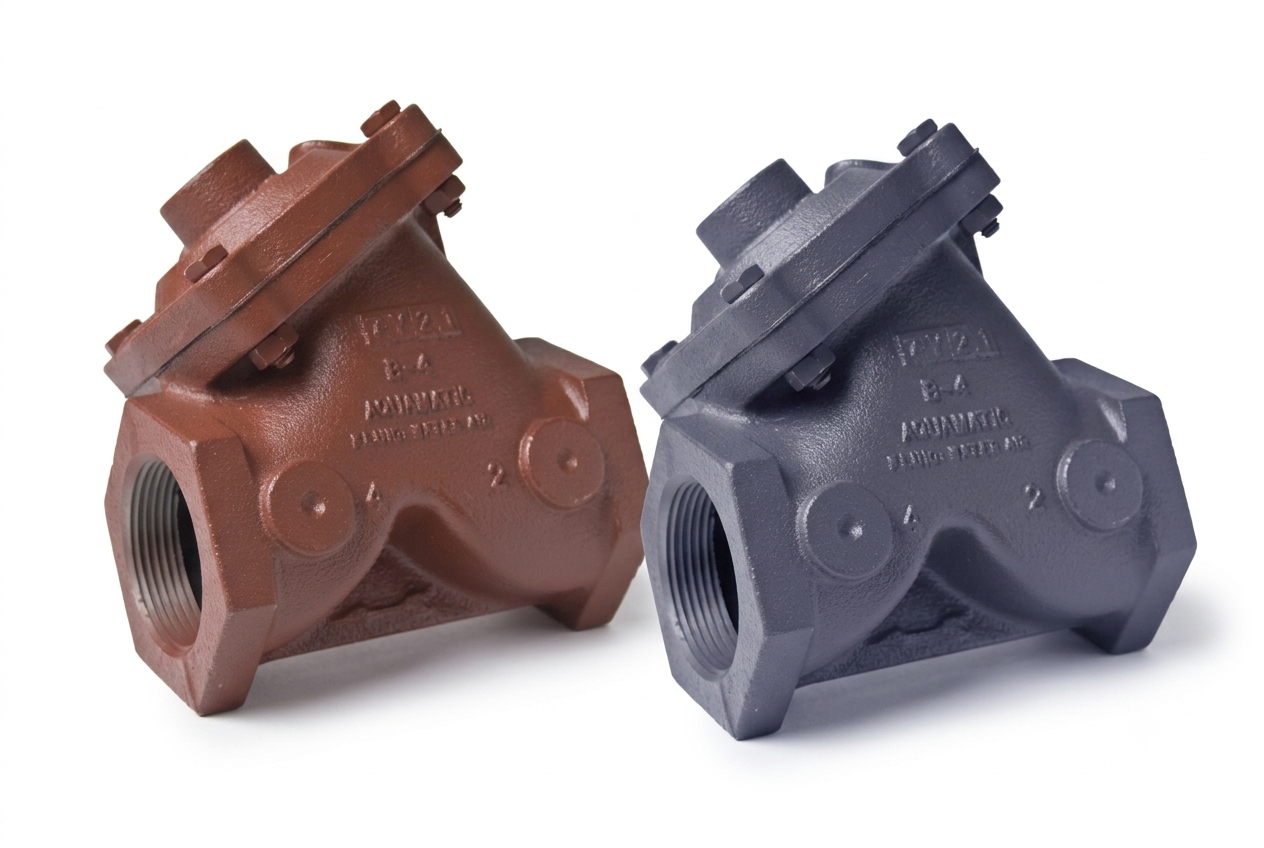
Most customers calling in about a V42 or a VAV already know they need an AquaMatic diaphragm valve. What they’re trying to figure out is which one. The two series look similar on a spec sheet, they share a similar body in several sizes, and they’re often compared side by side.
The VAV Series is built for air. The V42 Series is built for liquid service, with the option to be opened by either air or water pressure.
Both valves are built on the same AquaMatic diaphragm valve body, a design that’s been in service in water treatment, filtration, and industrial process systems for decades
The seat opening is larger than you’d expect for the line size, and the disc clears the seat by a wide margin when the valve opens. That gives flow more room to move through the body and keeps pressure drop low. In practice, that lets you size for the line rather than oversizing to compensate for restriction inside the valve.
Bodies and internal components are available in cast iron, brass, and stainless steel, with nitrile elastomer parts as the standard for the diaphragm and seals.
Both series are also designed for in-line service. The diaphragm sits in a separate chamber, isolated from the flow stream, so you can pull the cap and replace the diaphragm or seals without unbolting the valve from the pipe. For anyone managing a system with a dozen or more valves in it, that alone pays for itself the first time something needs attention.
Spring assist, position indicators, adjustable flow stops, high-temperature configurations, and options for both liquid and gas service are all available across both series.
The V42 and VAV were not designed to be interchangeable, even though they often look that way at a glance.
The VAV Series is built for high-cycle air applications. It’s rated for up to 200,000 cycles, which is four times the cycle life of a V42. If you’re running pneumatic equipment or any application where the valve is cycling constantly, that cycle rating is the number that matters. The VAV is built to take that kind of work without wearing out the diaphragm early.
The V42 Series is rated for up to 50,000 cycles and is the right choice for liquid service. It can be actuated by either air or water pressure, which is one of the reasons it shows up in such a wide range of systems. Water treatment plants, softeners, filters, irrigation, and industrial process applications all use the V42 because it adapts to whatever supply is already available on site. If the system runs on plant air, the V42 works. If it runs on line pressure water from a stager, the V42 works the same way.
The cycle-life difference is the easiest way to remember which valve is which. High-cycle air means VAV. General liquid service means V42.
Both series share the same threaded port range, but the V42 goes larger on the flanged side.
Size type | VAV Series | V42 Series |
Threaded | 3/4″ through 3″ | 3/4″ through 3″ |
Flanged | 3″ through 4″ | 3″ through 6″ |
The V42 K (4″) and V42 L (6″) are the two sizes that don’t have a VAV equivalent. For high-capacity systems or larger main-line valves, that often makes the decision for you on its own.
Most of the decision comes down to two questions. Is the valve cycling on air, and how often is it cycling?
The VAV Series is the right call when:
The V42 Series is the right call when:
Some applications could go either way. The decision often comes down to what’s already standard in the rest of the plant. If every other valve on site is a V42, sticking with V42 makes parts and seal kits easier to manage. If the application is borderline high-cycle and you’d rather not have to think about it again, the VAV is the better option.
Whichever series you pick, the diaphragm material matters as much as the valve body. Nitrile (Buna-N) is the standard and works well in general water service. EPDM is a better fit for chlorinated water, wastewater, and oxidizing environments. FKM (Viton) is the right call for chemical service and higher temperatures. We’ve written more about how material selection drives valve life in Why Valve Materials Can Fail in Water, Wastewater, and Chemical Systems.
Getting the right valve series is the first decision. Getting the right diaphragm material for the conditions is the second one.
If you’re replacing a valve that failed earlier than it should have, take a closer look at the application before you order the same thing again. The valve might have been right. The material, the cycle expectation, or the line size might not have been.
If you’re not sure which way to go, give us a call. We’ve been helping customers spec these valves for a long time, and a five-minute conversation usually saves a lot of back-and-forth later.
Browse the full lineup:
Have questions? Reach out at Sales@BuyAq-Matic.com or 980-458-2583.