
Moisture control is an important part of maintaining compressed air systems. When excessive water vapor remains in compressed air, it can lead to corrosion, equipment problems, and unreliable operation of components. Desiccant dryers remove moisture from the air before it reaches equipment that requires a dry air supply.
Maintaining a desiccant dryer involves more than replacing the drying media. In applications using AqMatic VAV air valves, the inlet and exhaust valves perform different functions during the drying and regeneration cycles.
Activated alumina is a porous aluminum oxide material commonly used to remove water vapor from compressed air and gas streams.
As compressed air passes through the desiccant beads, water vapor is captured on the activated alumina. This process, called adsorption, reduces the moisture content of the air passing through the dryer.
Many industrial desiccant dryers use two towers that alternate between drying and regeneration cycles. While one tower removes moisture from the compressed air, the other undergoes regeneration to remove accumulated moisture from the desiccant.
Proper regeneration, valve operation, and desiccant condition are all important to maintaining the required outlet dew point.
Valves direct airflow through the dryer and help control the different stages of the drying and regeneration process. Inlet valves control designated flow paths into the system, while exhaust valves are used to release air during regeneration.
The exact valve arrangement depends on the dryer manufacturer and system design.
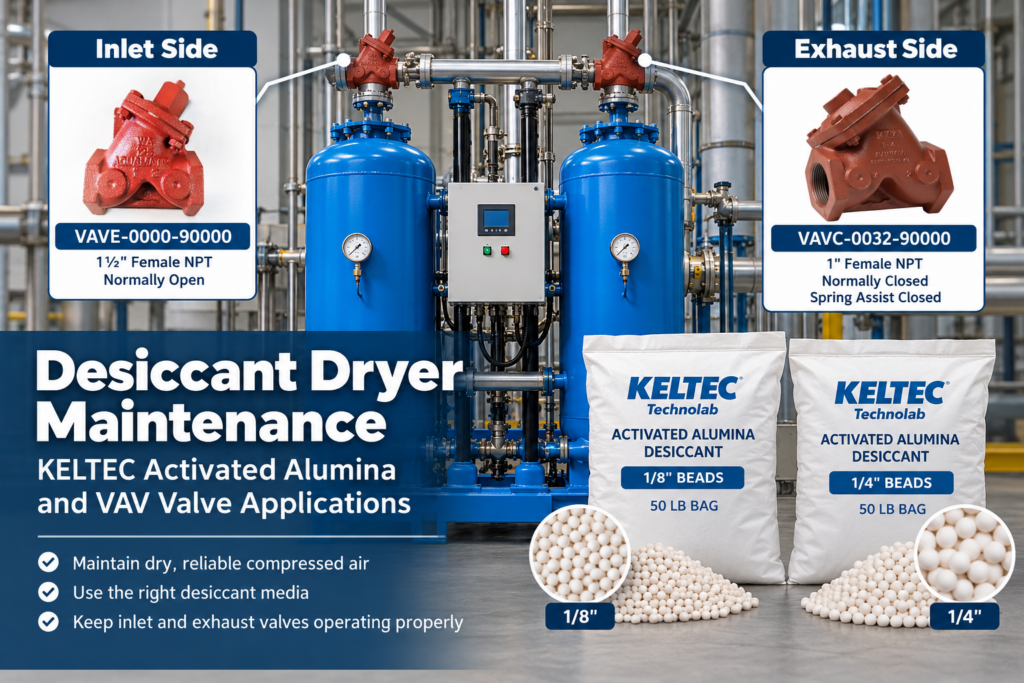
The AqMatic VAV air valve series includes valves available in different sizes and operating configurations. Two common AqMatic products used in desiccant dryer applications are the VAVE-0000-90000 inlet valve and the VAVC-0032-90000 exhaust valve.
The AqMatic VAVE-0000-90000 is a 1 1/2″ female NPT, normally open valve used in inlet-side applications.
The valve features a cast iron body and diaphragm-operated design. Its normally open configuration allows flow through the valve in its normal, unactuated operating state, with opening and closing controlled by the system’s operating sequence.
In a desiccant dryer, inlet valve operation coordinate with the dryer controls and other valves to direct compressed air through the intended flow path.
The AqMatic VAVC-0032-90000 is a 1″ female NPT, normally closed valve with a spring-assist closed configuration.
Used on the exhaust side of compatible desiccant dryer systems, this valve helps control air release during the appropriate stage of the operating sequence.
The normally closed configuration and spring-assisted closing mechanism provide a different operating arrangement from the normally open inlet valve.
Proper valve operation is particularly important when switching between drying and regeneration cycles.
The size of the activated alumina beads can affect airflow resistance and moisture transfer through a desiccant bed. Buy AqMatic offers two KELTEC Technolab activated alumina products for compatible compressed air dryers and gas drying systems.
The KELTEC Technolab 1/8″ Activated Alumina Desiccant uses smaller beads that provide greater external surface area per unit volume compared with larger beads.
This can support moisture transfer in appropriately designed desiccant beds. However, smaller beads generally create greater resistance to airflow, which can increase pressure drop through the dryer.
The product comes in a 50 lb bag for replacement and industrial dryer maintenance applications.
The KELTEC Technolab 1/4″ Activated Alumina Desiccant uses larger beads that can help reduce pressure drop compared with smaller media in certain dryer configurations.
Larger beads may be specified for particular dryer designs, operating conditions, or desiccant bed arrangements.
This product is also supplied in a 50 lb bag.
Although both products use activated alumina, the bead sizes are not automatically interchangeable. Maintenance personnel should confirm the desiccant type, bead size, and required quantity before replacing media in an existing dryer.
A rise in outlet dew point is often one of the first indications that the drying system needs attention. If the dryer can no longer maintain the specified dew point, investigate the possible causes before deciding which components require service.
Activated alumina may lose effectiveness because of contamination, physical damage, or prolonged exposure to operating conditions outside the dryer’s design requirements.
During maintenance, inspect the condition of the media and associated filters, screens, and dryer components. Replacement intervals should follow the equipment manufacturer’s recommendations.
According to a comparative study by BASF published in Hydrocarbon Engineering (May 2023), activated alumina typically has an in-service life span of 3 to 4 years, though actual replacement timing depends on operating conditions and the dryer manufacturer’s guidelines.
A desiccant dryer also depends on its valves operating in the correct sequence.
An inlet valve that fails to open or close as intended can interfere with airflow through the dryer. An exhaust valve that does not function properly can affect regeneration, depressurization, or the operating cycle, depending on the system design.
Maintenance inspections should consider valve actuation, sealing, control signals, and the condition of serviceable internal components.
For AqMatic VAV valves, Buy AqMatic offers replacement parts and repair kits, including the AV1-RA Diaphragm and Seal Kit and the 421-RG Internal Parts Kit for Normally Closed Valves. Kit compatibility should be confirmed against the specific valve model and configuration before ordering.
Desiccant replacement provides an opportunity to evaluate other components involved in dryer operation.
Before beginning service, technicians should review the manufacturer’s maintenance procedures and confirm that the system has been properly isolated, depressurized, and made safe for maintenance.
For systems using AqMatic VAV valves, identifying the installed valve model and operating configuration is important when ordering replacement parts.
Using the correct replacement materials helps maintenance personnel complete service without unnecessary delays.
Buy AqMatic offers several products used in desiccant dryer applications, including the VAVE-0000-90000 inlet valve, VAVC-0032-90000 exhaust valve, and KELTEC Technolab activated alumina desiccant in 1/8″ and 1/4″ bead sizes.
These products serve different functions within the drying system. The valves control airflow according to the dryer operating sequence, while activated alumina removes water vapor as compressed air passes through the desiccant bed.
Keeping both valve operation and desiccant condition within the equipment manufacturer’s requirements is an important part of maintaining dryer performance.
Explore Buy AqMatic’s VAV air valves and replacement Parts & Accessories, or review the two KELTEC activated alumina products to find the bead size specified for your dryer.