
Valve failures almost never happen all at once. It could be a slight leak during a pressure change or a valve that doesn’t quite seal the way it used to. The system keeps running, so it gets noted and pushed down the list. What seemed like a small issue becomes harder to ignore.
Eventually the valve needs to be replaced. But if you’ve seen it happen more than once, especially in the same system, it starts to raise a different question. Aquamatic valves should last for years, if not decades. Premature failure can be a sign we should make a change in your application.
Not what failed, but why it failed.
In many cases, replacing the entire valve doesn’t fix the issue. When replacing a valve, we have the opportunity research and change the diaphragm material if needed. This is especially true where material selection often determines lifespan more than the valve itself.
When people talk about valve materials, they’re usually thinking about what they can see. Choosing cast iron, pvc, or stainless steel matters, especially when it comes to pressure and corrosion, but they’re rarely what causes a valve to stop doing its job.
The failure almost always is in the part doing the work.
Inside the valve, the diaphragm is constantly moving. It flexes every time the valve opens and closes. It’s also the part that takes the full exposure of whatever is moving through the system. Clean water behaves one way. Treated water behaves differently. Wastewater introduces variability. Chemical applications change everything.
If that material isn’t right for those conditions, it doesn’t matter how well the rest of the valve is built. Sooner or later, it gives out.
That’s why in many cases, replacing the entire valve doesn’t fix the issue. In certain situations, changing the diaphragm material can increase the lifespan of the valve.
Small differences in chlorine exposure, temperature, or chemical concentration can completely change how materials behave over time. In standard water systems, Buna-N performs well and is commonly used in general-purpose setups. In wastewater systems, durability matters more, which is why EPDM is often paired with K52 valves or K53 valves.
For chemical applications, FKM is often the safer choice, particularly in higher temperature or aggressive environments.
Two systems can look almost identical on paper. Same valve model. Same configuration. Same general application. But small differences in operating conditions can completely change how materials behave over time.
Chlorine is one of the more common examples. In lower concentrations, a material like Buna-N can perform reliably for a long time. Increase the exposure or extend it across more cycles, and it begins to harden and lose flexibility. The valve still operates, but the seal isn’t what it used to be.
Liquid vs. air is another common example. For a high cycle, air application, you will want the VAV Series valves. The VAV Series is rated for up to 200,000 cycles where the V42 Series is rated up to 50,000.
Temperature works the same way. A system that runs fine under moderate conditions can start to break down faster once heat is introduced. Materials that were stable begin to degrade at a different rate, often without any obvious change in how the system is being used.
Then there are chemical environments. Two applications might both be labeled chemical, but behave very differently depending on concentration, exposure time, and cycle frequency. That’s why copying a previous setup, even one that worked well somewhere else, can lead to the same failure repeating itself.
Most of the real decision-making comes down to the diaphragm material, not the valve body.
Material | Where it tends to work well | Where it tends to break down |
Buna-N | Standard water systems, stable conditions | Chlorinated water, higher temperatures |
EPDM | Chlorinated water, wastewater, oxidizing environments | Certain oils and specific chemical exposures |
FKM (Viton) | Chemical applications, higher temperatures | Higher cost, unnecessary for basic water systems |
HYCAR | Air dry, sandblasting | Chemical exposure |
One of the most common mistakes is replacing a failed valve with the exact same configuration. If the failure was caused by material incompatibility, then the pattern will repeat.
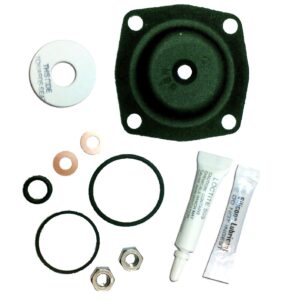
In many cases, the better choice is to keep the valve and change the internal components. Switching to the right diaphragm seal kit for the actual conditions often solves the problem without replacing the entire valve.
Instead of asking which valve to use, it’s usually more useful to ask what in the system is most likely to break the material down. This usually points back to a few things.
Once those are clear, the material choice becomes much more straightforward. And more importantly, it tends to last. Getting the material right doesn’t change how the system performs on day one. It changes how long it performs without becoming a problem.
In a lot of cases, it also means replacing a diaphragm instead of replacing an entire valve, which is where the real savings start to show up.
If a valve failed earlier than expected, there’s a reason.
And more often than not, it comes back to the material inside the valve, not the valve itself.
Fix that, and everything else tends to last longer.
Have questions about which material fits your application? Reach out to us as Sales@BuyAq-Matic.com or 980-458-2583.