Choosing the Right Valve for Water or Wastewater Facilities
Selecting the right valve for water and wastewater facilities directly affects system reliability, maintenance workload, and long-term operating cost. Valves operate under fluctuating pressures as pumps cycle, tanks fill and drain, and demand shifts throughout the day. Many systems carry suspended solids, treatment chemicals, disinfectants, and temperature swings that accelerate elastomer fatigue and metal corrosion.
Valve selection influences more than flow control. It determines how long a system remains offline during repairs, and how much spare inventory must be carried on site. A valve that requires full removal for rebuilding introduces downtime that most treatment facilities cannot absorb. Long service life, predictable maintenance intervals, and accessible rebuild procedures define whether a valve performs reliably over years of continuous operation.
AQ Matic valves have served municipal and industrial markets for more than 80 years with a track record built around durability, repeatable performance, and service access. For water and wastewater applications, the AQ Matic V42 Series diaphragm valve remains a dependable choice across a wide range of operating conditions.
Why Choose the AQ Matic V42 Series Valve?
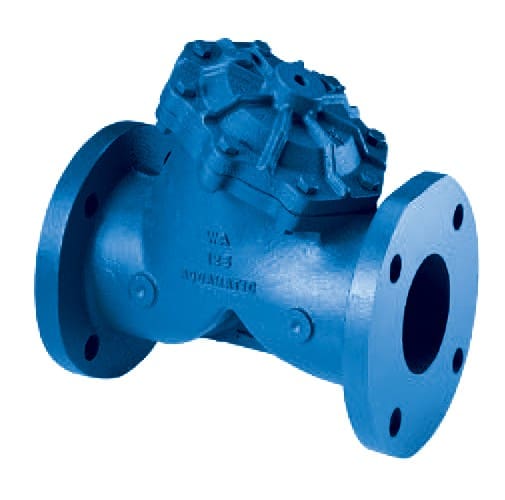
The AQ Matic V42 Series is a cast iron or cast brass Y pattern diaphragm valve designed for liquid service in demanding environments. The valve supports stable flow control, repeatable shutoff, and field serviceability without requiring removal from the pipeline.
Key Advantages of the V42 Series
Long service life
A 50,000+ cycle rating aligns with duty cycles seen in chemical feed systems, filter backwash sequencing, distribution pressure control, and automated pump staging. Reinforced diaphragms distribute flex stress evenly across the membrane, limiting edge cracking and loss of sealing force. Stress-relieved elastomers preserve shape memory under repetitive loading, maintaining shutoff integrity across extended operating periods.
In-line serviceability
Internal components can be serviced while the valve body remains installed in the line. This avoids draining long pipe runs, breaking flanged joints, and re-aligning piping supports. Facilities with limited bypass piping maintain operational continuity during diaphragm replacement and inspections while reducing labor exposure and outage duration.
Fast availability
Short lead times reduce operational risk during unplanned failures and seasonal peak demand periods. Predictable replenishment minimizes the need for temporary piping, rental equipment, and manual workarounds.
Buna elastomer construction
Nitrile elastomers tolerate continuous exposure to potable water, wastewater, mild chemicals, and treatment additives. Abrasion resistance limits wear in systems carrying fine solids. Elastic recovery maintains consistent seat contact across wide temperature ranges and high cycle counts.
Features & Benefits of AQ Matic V42 Diaphragm Valves
The V42 Series balances hydraulic performance, mechanical durability, and service access while controlling pressure loss and maintenance burden.
Performance & Design Benefits
Large seat opening and high lift disc
A larger effective flow area reduces internal velocity and turbulence, limiting erosion at the seat and body surfaces. Lower head loss supports predictable downstream pressure control and reduces pump loading over extended operating periods.
Separate flow and control chambers
Isolating the diaphragm from the process fluid prevents direct exposure to suspended solids, disinfectants, and chemical additives. The control chamber remains clean and dry, protecting actuation components and preserving repeatable closing force without reliance on mechanical springs.
Optional spring assist
Low differential pressure systems, gravity-fed lines, and vertical piping benefit from spring assistance to maintain positive closure. Self-draining installations avoid trapped water that can lead to freezing, microbial growth, and internal corrosion.
Lifecycle cost control
Service access influence operating expense more than initial purchase cost. Diaphragm replacement requires minimal tooling and short service windows. Reduced pressure loss lowers energy demand in pumped systems across the life of the installation.
Separate diaphragm chamber protection
The diaphragm remains isolated from abrasive flow conditions, extending elastomer life and stabilizing sealing performance.
In-line servicing capability
Routine maintenance proceeds without full system shutdown or pipe removal, preserving uptime in critical infrastructure.
Construction & Compatibility
Cast iron and brass bodies provide structural rigidity and vibration tolerance in pump rooms and mechanical galleries
Stainless internal components resist corrosion in humid and chemically active environments
Available sizes
¾″ to 3″ threaded NPT or BSP
3″ to 6″ flanged drilled to ASA 16.1 Class 125 or BSP 4504
Air or water actuation supports integration with industrial control panels and PLC systems
Threaded configurations support skid assemblies and compact piping systems. Flanged configurations integrate directly into municipal piping standards and retrofit projects.
Available Options for the V42 Series Valves
The V42 Series supports configuration flexibility to align with system requirements and operating conditions.
Optional configurations include:
Seal and diaphragm materials selected based on temperature exposure, chemical compatibility, and cycling frequency
Configurations suitable for liquid and gas service
Adaptation to a wide range of control devices
Spring assist in open or closed orientation based on fail-safe requirements
Position indicators for commissioning and routine inspections
Limit stops for mechanical flow restriction without altering control logic
High temperature service configurations for elevated process environments
Solenoid Compatibility & Control Options
In most installations, the V42 Series operates in conjunction with a solenoid valve that controls actuation.
Solenoid options include:
Energize to open
Energize to close
Voltage options
115V 60 Hz
220V 50 Hz
24V 60 Hz
24V DC
Solenoid selection affects response time, electrical load, and control reliability. Voltage compatibility supports standard industrial power distribution and control cabinet architectures. Actuation logic aligns with safety interlocks, emergency shutdown protocols, and site operating procedures.
These valves integrate cleanly with PLC outputs, relay logic, and automated sequencing used in pump control, chemical dosing, and treatment processes.
These environments prioritize predictable service intervals, stable flow behavior, and rapid repair capability.
Valve Selection Considerations for Water and Wastewater Systems
Engineering evaluation focuses on operating pressure range, differential pressure, flow demand, allowable pressure loss, solids content, chemical exposure, ambient temperature, cycle frequency, service accessibility, control voltage standards, and spare parts availability. Matching these parameters to valve design characteristics reduces failure risk and simplifies long-term maintenance planning.
Final Thoughts
For water and wastewater facilities that prioritize uptime, service access, and predictable operating behavior, the AQ Matic V42 Series diaphragm valve delivers proven performance across municipal and industrial environments. Long cycle life, in-line serviceability, material compatibility, and flexible control integration support reliable operation under continuous duty conditions.