
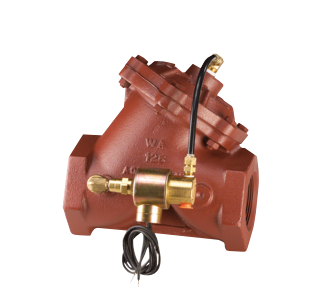
In most systems, a solenoid works alongside an AquaMatic K52 diaphragm valve or an AquaMatic V42 diaphragm valve by managing pressure in the upper diaphragm chamber.
Solenoid valves do not directly control process flow in AquaMatic diaphragm valve systems. Instead, they control pressure. That pressure determines whether a diaphragm valve opens or closes.
When pressure is applied to the upper diaphragm chamber, the valve closes. When pressure is released, the valve opens. In practice, that means the solenoid is not just an accessory. It is part of the control logic that determines whether the valve responds cleanly, drifts out of sequence, or starts creating maintenance problems that look like valve failure but are really control failure.
If that control signal is inconsistent, the system shows it quickly. Valves begin to chatter. Backwash cycles drift. A system that should be running automatically starts needing manual intervention. That is why the pairing between the solenoid and the diaphragm valve matters more than a generic product description usually suggests.
If you are configuring a system, start with the right control component: View available solenoid valves
In a normally closed configuration, energizing the solenoid vents pressure and allows the valve to open. In a normally open configuration, energizing the solenoid pressurizes the chamber and forces the valve closed. That sounds straightforward, but the field problems usually show up in the small details.
Control pressure stability matters because a diaphragm valve responds to changes in pressure, not brute mechanical force. If inlet pressure fluctuates, the valve can open late, close slowly, or fail to seat consistently.
Pilot line condition matters for the same reason. A partially restricted pilot passage may not look like a major issue, but it can slow pressure transfer enough to change response timing.
Timing matters even more in multi-valve systems. In systems using AquaMatic stagers for sequential valve control, even small delays between valves can break sequencing. One valve opens slightly late, another closes too slowly, and suddenly the problem appears to be the valve when the real issue is the control path leading to it.
Valve failures almost never happen all at once. In a typical filtration setup, a system may begin to show inconsistent backwash cycles. At first, it looks like a failing valve because one valve opens late and another does not fully close.
The instinct is to replace the valve. But many times the real issue is upstream. A partially clogged pilot line slows pressure release. That delay throws off the stager timing. The entire sequence begins to drift, even though the diaphragm valves themselves are still functional.
That distinction matters for both troubleshooting and selection. If you treat every response problem like a bad valve, you replace parts without fixing the real source of the failure.
When comparing the AquaMatic K52 and AquaMatic V42, material is only part of the decision. What matters more is how the valve will behave over time inside your system.
Media exposure and chemical conditions are often the first deciding factor. If the system handles aggressive water, fertilizers, or chemical injection, the question is not just whether the body will corrode. It is whether long-term exposure will change sealing consistency, response time, and maintenance frequency. The composite construction of the K52 helps remove corrosion as a variable, which is why it is often the better fit where chemical resistance and long-term consistency matter most.
System pressure and mechanical stress can point the other direction. In higher-pressure systems or installations where physical stress is part of normal operation, the V42 is often the better choice. Its metal construction gives it the strength needed for more demanding conditions.
Flow efficiency and pressure loss also deserve more attention than they usually get. The K52’s Y-pattern design reduces pressure loss through the valve. In a simple one-valve setup that may not change much. In a staged system with multiple valves, those small pressure losses can stack up and affect overall performance.
System complexity is the final filter. In a basic on-off application, either valve can perform well when configured correctly. In automated systems, consistency becomes more important than peak performance. A valve that responds the same way every cycle is more valuable than one that looks better on paper but introduces variability.
For a product example in a high demand application, see this 3/4″ V42 configuration with custom solenoid.
These systems are commonly used because they solve problems without adding potential mechanical points of failure.
Fewer mechanical components is part of the appeal. Instead of relying on a large external actuator, the valve uses system pressure to do the work. That usually means fewer wear points and fewer components drifting out of calibration over time.
Predictable response is another reason. When control pressure is stable and pilot paths are clear, diaphragm valves operate with repeatable timing. That matters in water treatment, filtration, and process systems where sequencing is part of normal operation rather than a rare event.
Inline serviceability is also a practical advantage. Many AquaMatic valves can be serviced without removing them from the line. That reduces downtime and makes maintenance easier in active systems where shutdowns are disruptive or expensive.
Compatibility with automated controls is the last major reason this design persists. These valves integrate well with solenoids, stagers, and controllers. The system stays relatively simple while still supporting automatic operation.
Where these systems get a bad reputation is when the control environment is ignored. Blocked pilot lines, unstable supply pressure, or the wrong solenoid configuration can all create performance issues that get blamed on the valve itself.
In most real installations, the solenoid and diaphragm valve are only part of the control picture. They work within a larger control setup, and that context is what determines whether the system runs reliably or constantly needs adjustment.
Stagers handle sequencing. In a staged filtration or softening system, the stager controls the order in which valves open and close. If valve response timing does not match stager timing, the process drifts out of sequence.
Controllers handle timing and logic. They determine how long each stage runs and when transitions occur. Incorrect timing often looks like valve failure when the real issue is in the control logic.
Pilot valves and pressure regulation components handle pressure delivery to the diaphragm chamber. Restrictions or instability here often show up as delayed or incomplete valve operation. That is why troubleshooting the valve in isolation can be misleading. The symptom shows up at the valve, but the source is often somewhere in the control path leading to it.
For a stager example that fits this type of control environment, see AqMatic Stager R058-SS79-03159.
What does a solenoid valve do in a diaphragm valve system? It controls pressure in the diaphragm chamber, which determines whether the valve opens or closes.
What is the difference between AquaMatic K52 and V42 valves? The K52 is a composite valve designed for corrosion resistance, while the V42 is a metal valve designed for higher-pressure and mechanically demanding applications.
When should I choose a K52 valve? Use the K52 when chemical exposure, corrosion resistance, and long-term consistency are the primary concerns.
When should I choose a V42 valve? Use the V42 when strength, pressure handling, and durability are more important than corrosion resistance alone.
How do stagers work with diaphragm valves? Stagers control the sequence of multiple valves, ensuring each valve operates at the correct time within a system cycle.
If you are unsure which combination of valves, solenoids, and stagers fits your system, these category and product pages give you a direct path into the catalog: